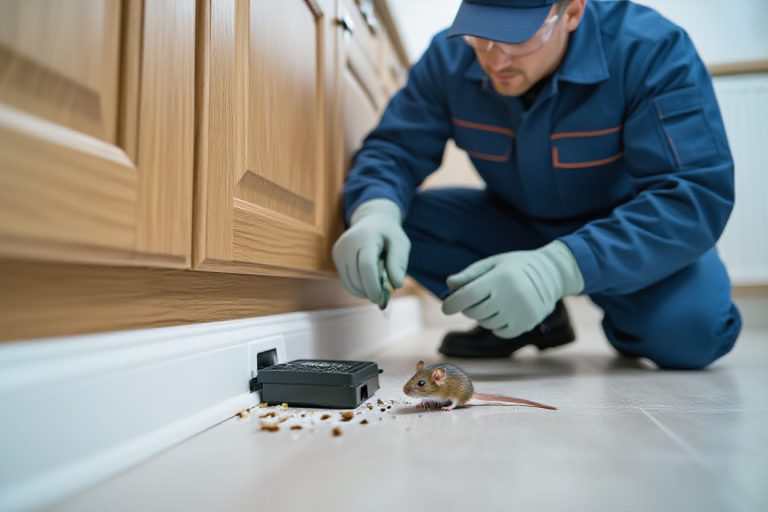
Mice and Rats in Oklahoma City Homes: Signs, Entry Points and What Works
In Oklahoma, the first cold snap of fall is usually when you start hearing scratching in the ceiling. Mice live near people all year. When the weather turns, OSU Extension’s Kevin Shelton says, they scramble to find shelter before winter, and a warm attic in Oklahoma City or a garage in Norman looks pretty good to them.
Below: the signs that you have mice or rats, the gaps they use to get in, and what OSU Extension and the U.S. EPA say about traps and baits. Most of it comes down to food, gaps and patience, whether you live in a ranch house in Moore or a two-story in Broken Arrow.
The house mouse
The rodent most people in Oklahoma homes are dealing with is the house mouse, Mus musculus. OSU describes it as mostly nocturnal, but it’s not unusual to see one in daylight. Seeing a mouse at noon doesn’t automatically mean you have hundreds of them. It doesn’t mean you can ignore it either.
Mice do damage in two ways. They chew wiring, drywall, boxes and food packaging. They also contaminate food and stored goods with urine and droppings. Chewed wiring is the part that should get your attention.
Signs you have mice
OSU Extension housing specialist Gina Peek lists the telltale signs:
- Droppings along runways and near feeding spots. Under sinks, in the back of pantry shelves, along baseboards and in drawers are common places to find them.
- Tracks in dust, or on shelves where flour is stored.
- Gnaw marks on food boxes and bags, on doors and on other surfaces.
- Smudge or rub marks along routes they use a lot. Oil and dirt from their fur leaves a dark line along walls and pipes.
- Sounds of running across the ceiling or climbing inside walls, usually at night.
- Nests in attics, basements, storage sheds and garages.
If you’ve found droppings somewhere odd, we’ve written about a few specific cases: mouse poop in the bathtub, mice in a drop ceiling and dead mice in the basement.
How they get in
Rodents fit through much smaller gaps than most people expect. An OSU food-facility sanitation fact sheet puts it in numbers: rats can get through an opening larger than 1/2 inch square, and mice through one larger than 1/4 inch square. That’s about the width of a pencil for a mouse. The same fact sheet notes that rats can jump about 36 inches straight up, climb pipes, cables and vines, and gnaw through materials as hard as cinder block and aluminum.
Places to check around a typical Oklahoma house:
- Where water, gas and electrical lines come through the foundation or siding.
- Under garage doors that don’t seal tight against the slab.
- Around dryer vents and HVAC lines.
- Gaps in soffits and roof returns. OSU specifically mentions sealing holes in walls and soffits.
- Under sinks where pipes come through the cabinet floor.
Because rats can chew through cinder block and aluminum, sealing is really about making the gaps small and tough. OSU’s facility guidance calls for closing openings completely and fitting doorways with flashing and rodent brush, which is a tight brush strip along the bottom of the door. At home, that means a good door sweep on the garage entry door and a proper seal on the garage door itself.
Take away food, water and shelter first
Shelton’s advice is to focus first on cutting food sources, closing entry points and getting rid of hiding places, and to think of traps as a last resort. OSU’s list of steps:
- Get rid of food and water sources.
- Take household garbage outside to a bin with a tight lid.
- Feed pets only what they’ll eat at one time, and store pet food in a container with a tight-fitting lid.
- Fix indoor and outdoor water leaks.
- Store firewood away from the house and up off the ground.
- Clear rubbish and trash from around the outside of the house.
- Cut down clutter inside, especially in garages and storage rooms.
Birdseed and pet food in the garage are two of the biggest draws. Move them into metal or heavy plastic bins with lids.
Trapping
Snap traps may seem old-fashioned, but Shelton calls them an effective method of rodent control. A few details make a big difference:
- Put traps where the mice are. Mice have small territories, so a trap across the room from the droppings may never get visited.
- Placement and direction matter. Shelton says to read the package directions, because how a trap is placed and which way it faces affect whether it works.
- Use several traps. One trap for an active infestation won’t keep up.
Skip glue traps
Peek recommends avoiding glue traps. They catch whatever touches them, including animals you didn’t mean to catch, and an animal stuck to the board usually dies slowly of starvation or suffocation.
Ultrasonic repellers
Plug-in ultrasonic devices are sold everywhere. According to Shelton, mice are timid and will run from a lot of sounds, but they get used to these devices within a day or two.
Rodent baits and safety
OSU points out that mice aren’t protected by law, so they can be controlled with any pesticide registered by federal or state authorities for that purpose, or by mechanical methods like traps. If you use bait, Shelton’s advice is to always use an enclosed bait station, never put it where children or pets can reach it, and use a little bait in several stations since mice are nibblers.
The EPA explains what’s on store shelves. Most rodenticides are anticoagulants, which stop blood from clotting. Rodents usually die four days to two weeks after they start eating the bait. The strongest anticoagulants, known as second-generation products, are no longer sold to consumers because of the risk to pets and wildlife. They’re registered only for commercial and structural pest control. Consumer products now come as ready-to-use bait stations with block or paste bait. Loose pellet baits are no longer allowed in consumer rodenticide products.
One practical downside of poison bait in a house: a mouse that eats it may die inside a wall or under an appliance. If you’ve ever had that smell, you know. See does a dead mouse smell like gas? and a dead mouse under the fridge.
Mice or rats?
Size is the quickest tell. Adult rats are much bigger than mice, and their droppings are noticeably larger. The difference matters because rats fit through bigger gaps, need bigger traps and can climb and jump farther, as the OSU numbers above show. If you’re finding large droppings or chew marks on thick materials, treat it as a possible rat problem and size your traps and sealing to match.
When to bring in a pro
If you’ve sealed the obvious gaps and kept trapping and you’re still catching mice after a couple of weeks, something is still letting them in. A pest control company can look for entry points you can’t easily reach, like rooflines and soffits. In Oklahoma, any company applying rodenticides for pay has to be licensed by the Oklahoma Department of Agriculture, Food and Forestry.
BugDaddyOK is an Oklahoma pest information blog connected to Flatline Pest Control, a licensed Oklahoma company that handles mice and rats. Whoever you call, ask them to show you the entry points they find. Sealing is what keeps the next batch out.
Related Oklahoma pest guides
- Found a dead mouse in the toilet?
- A dead mouse in the refrigerator motor
- Ants in Oklahoma homes
- Brown recluse and black widow spiders in Oklahoma
Sources: Oklahoma State University, There’s a Mouse in the House; OSU Extension, Process and Facility Sanitation (FAPC-121); U.S. EPA, Restrictions on Rodenticide Products.